What happened in the Snorre A Blowout (2004): 7 facts to know

On the night of 28 November 2004, personnel standing on the deck of the Snorre A platform in the Norwegian North Sea watched the sea beneath them begin to boil.
Not from heat, but from gas. High-pressure formation gas, migrating uncontrolled through the seabed, venting directly beneath a floating tension leg platform with a flare boom still burning overhead.
The Petroleum Safety Authority Norway called it one of the most serious incidents ever recorded on the Norwegian Continental Shelf.
And yet most oil and gas professionals outside Norway have never heard of it.
This is the Snorre A blowout. Here are 7 facts every well control professional should know about it.
1: What was Snorre A?

Snorre A was a tension leg platform (TLP) operated by Statoil, located in the Norwegian North Sea approximately 150 km northwest of Bergen. A TLP is a floating structure held in place by 16 steel tethers anchored vertically to the seabed making it particularly vulnerable to gas venting directly beneath the hull. The incident occurred during a workover campaign on Well 34/7-P-31A, a well with a documented history of casing damage, stuck drillstring events, and a non-standard completion. It had been shut in since December 2003.
2: What went wrong
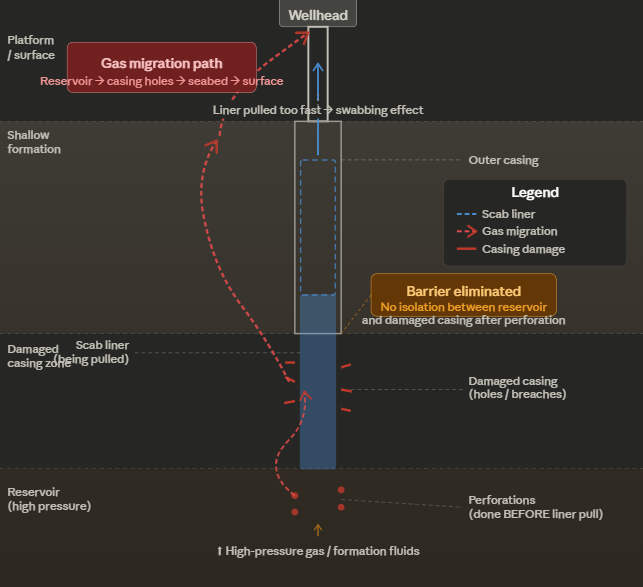
The workover required pulling a 'scab liner', a temporary casing patch covering damaged sections of the wellbore.
The critical error: the well had already been perforated before the liner was pulled. This eliminated the barrier between the reservoir and the damaged casing, creating a direct migration path for high-pressure gas.
When the liner was pulled too quickly, the resulting swabbing effect allowed formation gas to enter the wellbore and travel through casing holes into shallow formations beneath the seabed & upward toward the platform.
3: The "Boiling Sea" Moment

At approximately 20:30 on November 28, 2004, personnel on deck observed the sea surface around the platform visibly churning with gas, described in witness accounts as the sea "boiling." Emergency shutdown was triggered manually.
At that moment, Snorre A's flare boom was still alight. An ignited gas cloud of that concentration, beneath a floating TLP structure, had the potential for a catastrophic explosion.
The platform's 216-person crew was partially evacuated by helicopter within the hour, with 75 essential personnel remaining to manage the emergency response.
4: The PSA Found 28 Non-Conformities

The Petroleum Safety Authority Norway (PSA) investigated and identified 28 separate breaches of Norwegian petroleum regulations, an extraordinary number for a single incident.
Their overall finding: "The incident was not due to accidental circumstances, but a consequence of a general failure in Statoil's planning, procedures and assessments."
Root causes spanned well barrier management, risk assessment, management of change, organisational competency, and a culture of operational pressure that had incrementally eroded safety margins.
5: How close was it?

Very close, on multiple simultaneous fronts:
Ignition: The flare boom remained active as gas enveloped the platform. A single ignition source would have been sufficient for catastrophic explosion
Structural failure: Gas venting beneath a TLP reduces buoyancy. Engineers monitored tether tension continuously throughout the incident for signs of platform instability
Escalation window: From first gas detection to full emergency shutdown was a matter of minutes. A slower crew response would have materially changed the outcome
The PSA described it as one of the most serious incidents ever recorded on the Norwegian Continental Shelf.
6: Impacts
Category | Impact | |
Production loss | Snorre A shut in for approximately 2 months; field produces ~100,000 bopd | |
Well intervention costs | Multi-million dollar kill operation using heavy mud emulsion | |
Regulatory consequences | 28 non-conformities; mandatory rectification programme across Statoil's NCS operations | |
Reputational damage | PSA issued public statement citing systemic organisational failure, unusual severity for a regulator | |
Industry-wide cost | Triggered full revision of NORSOK D-010 and tightened well integrity regulations across the Norwegian shelf |
7: Key takeaways:
Lesson | Takeaway |
a) Well barrier sequencing is non-negotiable | Perforating before pulling the scab liner directly caused this blowout. Barrier philosophy applies to workovers, not just primary drilling |
b) A well's history must drive its risk classification | P-31A had documented casing damage and prior incidents. That history was available, it was not adequately weighted in pre-job planning |
c) Organisational change + high operational tempo = elevated risk | Statoil had taken over Snorre operations less than 2 years prior. Unclear responsibilities during high-activity periods are a recognised accident precursor |
d) Detection & shutdown procedures save lives | The crew's immediate, disciplined emergency response was the difference between a near-miss and a tragedy. Training to respond without hesitation is not optional |
e) Culture drives barrier integrity more than procedures do | Every failed barrier had a procedure behind it. What failed was the organisational culture that allowed incremental deviation under production pressure |
The Snorre A blowout is a core case study in modern well control training for a reason. it shows how barriers fail in competent organisations under real operational conditions.
Our IADC WellSharp and IWCF Well Control programmes are built around exactly this kind of operational reality. Whether you are preparing for certification or deepening your technical expertise, our courses give you the frameworks to recognise, respond to, and prevent barrier failures before they escalate.


![[PDF] Inhalation exposure: 30 Emergency response guidelines](https://static.wixstatic.com/media/cb6985_ef55d4f007d341e28d1e80baa42677c7~mv2.png/v1/fill/w_680,h_560,al_c,q_90,enc_avif,quality_auto/cb6985_ef55d4f007d341e28d1e80baa42677c7~mv2.png)
Comments